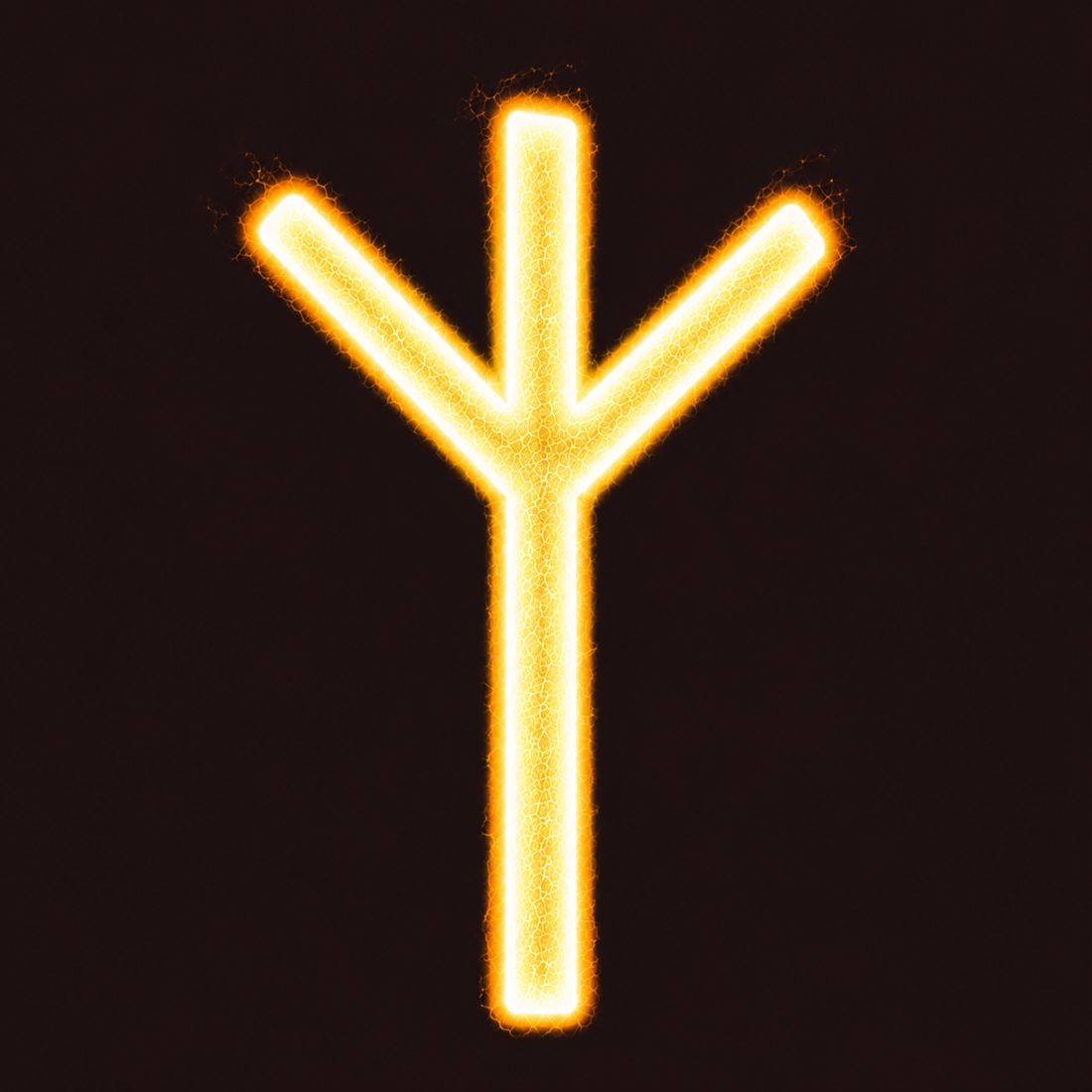
Elder Futhark
Algiz
Algiz: The Rune of Protection That Begins With Awareness
The decision not to enter a situation simply because everyone else is moving toward it.
Meaning & symbolism
Algiz: The Rune of Protection That Begins With Awareness
Protection is often imagined as something external.
A wall.
A shield.
A locked door.
Something standing between us and whatever might cause harm.
But some of the most effective forms of protection appear much earlier.
The uneasy feeling that makes you look twice.
The boundary established before someone crosses it.
The question asked before trust is given.
The decision not to enter a situation simply because everyone else is moving toward it.
The ability to recognize danger while there is still time to choose.
That is where Algiz—ᛉ, the fifteenth rune of the Elder Futhark—becomes particularly interesting.
Today, Algiz is one of the runes most strongly associated with protection, vigilance, intuition, spiritual awareness, and connection with something greater than ourselves.
Historically, however, its story is less certain.
The rune occupies the fifteenth position of the Elder Futhark and originally represented a sound conventionally reconstructed as z. Its name is reconstructed as Algiz or sometimes Elhaz, but scholars have debated both the original word and its meaning. “Elk” is a traditional reconstruction, while other linguistic interpretations have also been proposed. (Wikipedia)
That uncertainty matters.
Because the familiar image of ᛉ as an elk raising its antlers toward danger is compelling symbolism.
It just should not be mistaken for a securely documented explanation from the Elder Futhark period.
The historical Algiz is complicated.
The modern Algiz is protective.
Between them is an idea worth exploring:
The strongest shield may be the awareness that tells you when a shield is needed.
What Do We Actually Know About Algiz?
The Elder Futhark contained 24 runes and was in use among Germanic-speaking peoples during the early centuries CE before later runic systems developed. Algiz appears as its fifteenth rune, immediately after Perthro and before Sowilo. (World History Encyclopedia)
Its reconstructed name is unusually difficult.
Algiz has traditionally been interpreted as “elk,” but reconstruction is not certainty. The asterisk scholars place before names such as Algiz is important: it indicates a linguistic form reconstructed from later evidence rather than a name directly preserved beside the Elder Futhark rune itself. (Wikipedia)
The later Anglo-Saxon rune corresponding to ᛉ was called Eolh or Eolh-secg.
And this is where the history becomes even stranger.
The Old English Rune Poem does not clearly describe an elk standing proudly with antlers raised.
Instead, its stanza refers to eolh-secg, something dwelling in marshy water and capable of severely wounding anyone who grabs it. It is generally interpreted as some kind of sedge or marsh plant, although the exact identification has long been debated. (Wikisource)
That is not the history most people encounter when they first learn that Algiz is “the rune of protection.”
But it gives us something arguably more interesting.
Something that protects itself by being dangerous to grasp.
Protection Does Not Always Look Like a Shield
Imagine a plant growing in a marsh.
It cannot run.
It cannot raise a weapon.
It cannot consciously choose an opponent.
Yet its physical characteristics discourage careless contact.
Protection is built into the boundary between itself and the world around it.
That creates a powerful modern metaphor.
Not all protection requires aggression.
Sometimes protection is simply making the boundary clear.
This far. No farther.
That applies to people too.
You do not have to become hostile to protect your time.
You do not have to become cruel to protect your energy.
You do not have to hate someone in order to decide that they no longer deserve access to you.
A healthy boundary is not necessarily an attack.
It is information.
And awareness is what allows us to know where that boundary belongs.
The Elk Antlers: Powerful Symbolism, Later Interpretation
The shape of Algiz almost invites visual interpretation.
A central vertical line rises into two upward branches.
It can resemble antlers.
A tree.
A human figure with both arms raised.
Because the reconstructed name has often been connected with “elk,” modern rune traditions frequently interpret those upper branches as antlers—the natural defense of an alert animal.
That is evocative imagery.
But we should distinguish symbolic resemblance from documented historical explanation.
We do not have an Elder Futhark source telling us that the rune was designed to depict an elk raising its antlers defensively. The connection is an interpretation developed from the reconstructed name and the rune’s visual form. (Wikipedia)
Still, as a modern symbol, the image works remarkably well.
An elk does not need to attack everything around it.
Its antlers exist before the confrontation.
That is the difference between preparedness and aggression.
Real protection often works the same way.
Awareness Comes Before Defense
You cannot respond to something you do not notice.
That makes awareness the first layer of protection.
Pay attention to the environment.
Pay attention to patterns.
Pay attention to changes.
Pay attention to what people consistently do rather than only what they say.
This is where modern interpretations of Algiz as heightened awareness become useful.
Not because ᛉ magically detects danger.
Because the symbol can remind us to remain present enough to detect it ourselves.
Many problems announce themselves quietly before becoming obvious.
A relationship becomes increasingly one-sided.
An expense repeatedly exceeds what you can sustain.
Someone tests small boundaries before crossing larger ones.
A habit begins producing consequences.
A situation feels subtly different.
Awareness catches the early signal.
Ignoring it often leaves us dealing with the louder consequence later.
Instinct Is an Alarm, Not a Verdict
This naturally brings us to Instinct.
There are moments when something feels wrong before we can explain what is wrong.
Human beings process enormous amounts of information unconsciously.
Tone.
Pattern.
Facial expression.
Context.
Memory.
Experience.
Sometimes the resulting feeling arrives before the reasoning that produced it becomes conscious.
That makes instinct valuable.
It does not make instinct infallible.
Fear can imitate intuition.
Trauma can produce false alarms.
Desire can make dangerous possibilities look attractive.
Bias can turn unfamiliarity into suspicion.
So perhaps the wisest interpretation of Algiz is not:
Trust every feeling.
It is:
Notice the feeling, then investigate it.
Awareness receives the signal.
Wisdom evaluates it.
Then you decide.
Protection Without Discernment Becomes Fear
There is a danger in making protection the central organizing principle of life.
If everything is treated as a threat, eventually life becomes very small.
Do not trust.
Do not risk.
Do not open.
Do not change.
Do not let anyone close enough to hurt you.
You may become safer in some ways.
You may also eliminate Connection.
Every meaningful relationship contains vulnerability.
Every ambitious goal contains risk.
Every new direction carries uncertainty.
Protection therefore cannot mean eliminating exposure to everything capable of causing pain.
That would also eliminate much of what makes life meaningful.
Protection needs discernment.
Which risks are reckless?
Which are necessary?
Which people have earned trust?
Which boundaries need strengthening?
Which defenses have outlived the danger that created them?
A shield is useful when something is attacking.
Carrying it permanently in front of your face makes it difficult to see where you are going.
Perthro Leaves Us With Mystery. Algiz Asks Us to Stay Alert.
Algiz follows Perthro, perhaps the most historically mysterious rune in the Elder Futhark.
There is no evidence that this sequence was constructed as an ancient spiritual curriculum, so any progression we draw between them belongs to modern symbolic interpretation.
But the relationship is compelling.
Perthro represents the unknown in our contemporary reading.
The information we do not possess.
The future that has not revealed itself.
The outcome that remains uncertain.
Then comes Algiz.
We still cannot see everything.
So what do we do?
Pay attention.
Mystery does not require blindness.
Uncertainty does not require carelessness.
You can acknowledge that the future is unknowable while remaining extremely attentive to what the present is showing you.
Perthro asks us to tolerate uncertainty.
Algiz asks us not to become unconscious inside it.
Higher Guidance: History and Modern Spirituality
Modern rune practice frequently connects Algiz with higher guidance, divine protection, guardian forces, spiritual communication, or connection between the physical and unseen worlds.
These interpretations belong largely to later esoteric and contemporary spiritual systems rather than securely documented meanings from the Elder Futhark period.
That distinction does not require anyone to abandon a spiritual interpretation that resonates with them.
It simply keeps history and personal belief in their proper places.
For someone approaching Algiz spiritually, the raised shape may resemble a person reaching upward.
It can become a symbol of receptivity.
Prayer.
Listening.
Seeking guidance beyond the immediate ego.
For someone approaching it psychologically, the same form might represent expanded awareness.
For someone interested primarily in history, it remains an ancient runic character whose reconstructed name and later traditions are unusually complex.
A symbol can support multiple layers of meaning without requiring those layers to have the same historical origin.
That is one of the most interesting things about symbols.
They survive partly because people continue finding ways to think through them.
Guidance Is Not the Same as Certainty
Whether guidance is understood spiritually, intuitively, or psychologically, there is an important distinction.
Guidance points.
Certainty guarantees.
Very little in life comes with guarantees.
You may feel strongly called toward something and still encounter difficulty.
You may make the best decision available and still experience an unexpected outcome.
You may believe you understand the Path and later discover that the route needs to change.
That does not automatically mean the guidance was meaningless.
It means navigation is an ongoing process.
A compass does not tell you what exists beyond the horizon.
It tells you which direction you are facing.
Perhaps Algiz works best in that spirit.
Not:
Nothing bad will happen to me.
But:
I will try to remain aware enough to meet what happens intelligently.
The Strongest Protection Often Happens Early
Think about the kinds of protection that work best.
A seatbelt before the collision.
Savings before the emergency.
A boundary before resentment.
A difficult conversation before the relationship collapses.
A backup before the file disappears.
Rest before exhaustion becomes burnout.
Protection is often most effective when it appears almost unnecessary.
That is why vigilance matters.
When the danger becomes obvious, some options may already be gone.
Algiz can therefore symbolize preventive wisdom.
Notice early.
Ask early.
Prepare early.
Respond before the problem becomes large enough to force the response.
There is nothing dramatic about this kind of protection.
That is precisely why it works.
Protection sometimes demands immediate action.
But many situations allow something more valuable:
A pause.
What exactly is happening?
What do I know?
What am I assuming?
Is the threat real?
Is my reaction proportional?
What outcome am I trying to protect?
That last question is especially important.
Because people sometimes become so focused on defending themselves that they forget what they were trying to preserve.
A relationship?
Then the method of protection matters.
Your peace?
Then endless conflict may defeat the purpose.
Your future?
Then a short-term emotional victory may be expensive.
Reflection ensures that protection serves something beyond itself.
Then Know When to Act
Eventually, awareness has to become decision.
This is where Act returns to the symbolism.
You notice the pattern.
You understand the boundary.
You gather enough information.
Then comes the moment when continued observation stops being wisdom and becomes avoidance.
Say no.
Leave.
Speak.
Prepare.
Protect.
Change course.
Ask for help.
Algiz should not become a symbol of permanent defensive posture.
Sometimes protection requires movement.
Sometimes standing your ground.
Sometimes getting completely out of the way.
Wisdom lies in knowing which response the situation actually requires.
Resolve Protects What Matters Over Time
One boundary is easy to declare.
Maintaining it is harder.
That is where Resolve becomes part of protection.
People often test boundaries.
Circumstances test them too.
You decide not to repeat a harmful pattern.
Then the familiar opportunity returns.
You decide to protect your time.
Then someone asks for an exception.
You decide to change direction.
Then doubt appears.
The first decision may take courage.
The repeated decision takes resolve.
Protection is rarely one dramatic moment.
Often it is a pattern of ordinary choices saying:
What I decided mattered yesterday still matters today.
Connection Requires Selective Openness
Algiz and Connection may initially seem contradictory.
Protection closes.
Connection opens.
But healthy human relationships require both.
Without openness, intimacy cannot form.
Without boundaries, intimacy becomes unsafe.
Trust is not giving everyone unrestricted access.
It is gradually opening access where evidence supports it.
That means the opposite of protection is not connection.
The opposite of healthy protection may be indiscriminate exposure.
Strong boundaries can actually make deeper connection possible because everyone involved understands where responsibility begins and ends.
You can be generous without surrendering yourself.
Loving without accepting everything.
Open without becoming defenseless.
That is a more mature form of protection than building a wall around the entire world.
Perspective Determines What Looks Dangerous
Our perspective influences threat perception.
A challenge can look terrifying when viewed without experience.
After surviving something similar, the same challenge may look manageable.
Conversely, familiarity can sometimes make us underestimate genuine danger.
“We’ve always done it this way.”
“Nothing happened last time.”
“I’m sure it’s fine.”
Awareness asks us to keep updating perspective with evidence.
What has changed?
What am I missing?
Am I underreacting because something feels familiar?
Am I overreacting because something resembles an old experience?
Protection becomes wiser when perspective remains flexible.
Expansion Requires Exposure
There is an unavoidable tension between protection and expansion.
Growth requires leaving some degree of safety.
You cannot meet new people without risking rejection.
Cannot create publicly without risking criticism.
Cannot build something ambitious without risking failure.
Cannot learn something difficult without temporarily feeling incompetent.
Absolute protection prevents expansion.
Absolute exposure creates unnecessary danger.
The challenge is finding the middle.
Enough protection to remain grounded.
Enough openness to grow.
Algiz can represent that balance.
The point of the shield is not to hide behind it forever.
The point is to remain secure enough to continue moving.
Sometimes the Danger Is Internal
Not everything we need protection from comes from someone else.
People sabotage themselves.
Ignore warning signs.
Repeat destructive patterns because those patterns are familiar.
Talk themselves out of opportunities.
Allow fear to make decisions disguised as logic.
In those situations, awareness turns inward.
What am I doing repeatedly?
What consequences keep returning?
What belief is driving the pattern?
What would I notice if I observed my own behavior as carefully as I observe everyone else’s?
Protection sometimes means defending ourselves from our own worst habits.
That requires honesty more than strength.
The Symbol of Raised Arms
Another common modern visual interpretation sees the form of ᛉ as a human figure standing upright with arms raised.
Historically, we cannot demonstrate that this was the Elder Futhark rune’s intended pictorial meaning.
Symbolically, however, it creates a very different image from the shield.
An open posture.
Receptivity.
A person reaching beyond themselves.
That gives modern ideas of higher guidance and spiritual Connection an understandable visual language.
There is something beautiful in the contrast.
The same symbol can look like antlers defending—
or arms opening.
Protection and receptivity.
Those ideas do not have to oppose one another.
Perhaps the real challenge is learning when to do each.
When to close.
When to open.
When to defend.
When to receive.
The Unknown Does Not Mean You Are Unguided
Placed after Perthro, Algiz offers a useful symbolic response to uncertainty.
You will not know everything.
The future will not explain itself in advance.
But complete certainty is not the only resource available.
You have awareness.
Experience.
Relationships.
Knowledge.
Values.
Reflection.
For some people, faith also belongs on that list.
These things do not eliminate uncertainty.
They help us navigate it.
That may be the most grounded way to understand “higher guidance.”
Not as a guarantee that every decision will be correct.
As the practice of listening beyond immediate impulse.
What does experience say?
What do your values say?
What does evidence say?
What does your deeper intuition keep returning to?
What becomes visible when fear grows quiet enough for you to listen?
Guidance may not arrive as an answer.
Sometimes it arrives as a better question.
Protection Is Ultimately About What You Value
You do not protect everything equally.
You protect what matters.
Your health.
Your time.
People you love.
Your work.
Your dignity.
Your future.
Your principles.
That means every act of protection contains a hidden statement of value.
This is worth preserving.
Algiz therefore asks a question beneath the question of safety:
What are you protecting—and why?
Because it is possible to spend enormous energy protecting something that no longer deserves preservation.
An outdated identity.
Pride.
A harmful relationship.
A belief we are afraid to examine.
Not every defense is wise simply because it is strong.
Awareness must examine the thing inside the walls too.
The Shield Is Wisdom Before It Is Force
Historically, Algiz does not give us the simple story modern rune books often present.
Its reconstructed name is uncertain.
“Elk” remains a traditional interpretation, while alternative linguistic proposals exist. The later Anglo-Saxon poem gives us the mysterious eolh-secg, apparently something growing in wetland and capable of wounding anyone who seizes it. (Wikipedia)
The familiar meanings of divine protection, guardian energy, raised antlers, spiritual guidance, and higher awareness developed through later interpretation.
Keeping those layers distinct does not diminish Algiz.
It gives the symbol depth.
A creature that protects itself.
A plant dangerous to grasp.
Antlers raised toward the horizon.
Arms reaching upward.
A modern shield made not simply of force, but awareness.
All of those images eventually converge on the same human question:
How do we remain open to life without becoming careless with what matters?
Maybe protection begins by paying attention.
Trust your Instinct, but examine what it tells you.
Reflect before fear chooses for you.
Strengthen your Resolve when a boundary deserves maintaining.
Stay connected enough to receive wisdom from beyond your own perspective.
Then, when awareness becomes understanding, know when to Act.
Because the strongest protection is not always the wall built after danger arrives.
Sometimes it is the awareness that saw the danger while there was still time to choose another Path.
Feel the energy Follow your flow Make it so