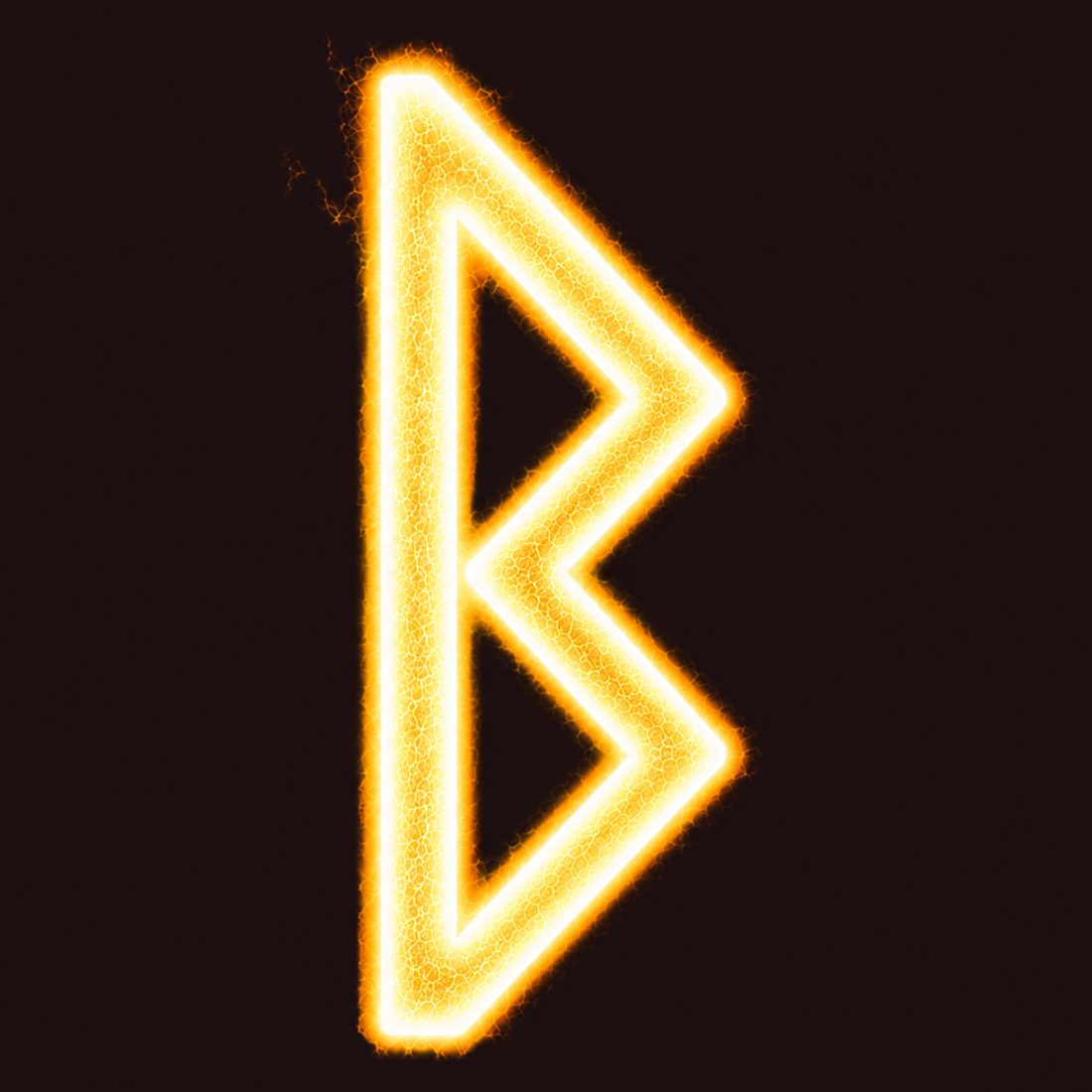
Elder Futhark
Berkano
Berkano: The Rune of the Birch and the Quiet Work of Beginning Again
A new direction may begin with nothing more dramatic than one small decision made differently from yesterday.
Meaning & symbolism
Berkano: The Rune of the Birch and the Quiet Work of Beginning Again
New beginnings rarely look impressive at first.
A forest does not return all at once.
A wound does not heal in a day.
Trust does not rebuild itself with one conversation.
A new direction may begin with nothing more dramatic than one small decision made differently from yesterday.
We celebrate transformation when it becomes visible.
But long before that point comes something quieter:
the conditions that allow new growth to survive.
That is where Berkano—ᛒ, the eighteenth rune of the Elder Futhark—becomes especially compelling.
Its reconstructed Proto-Germanic name, Berkanan, is associated with the birch tree, and that basic connection remains strikingly consistent across later Germanic runic traditions. Old English preserves Beorc or Berc, while Scandinavian traditions use forms such as Bjarkan. (Wikipedia)
Modern rune traditions have carried the birch into ideas of renewal, fertility, nurturing, healing, compassion, growth, and new beginnings.
Those broader spiritual meanings should not simply be presented as established Elder Futhark doctrine.
But the birch itself gives us something powerful enough:
A tree associated with life.
Growth.
Persistence.
And the ability of living systems to begin again.
The Birch at the Historical Core
Berkano occupies the eighteenth position in the 24-rune Elder Futhark and represents the b sound. The Elder Futhark was the earliest classified runic script and remained in use in the Germanic world until roughly 700 CE. (World History Encyclopedia)
The reconstructed name Berkanan means birch, although—as with other reconstructed Elder Futhark names—the precise ancient form is inferred from later linguistic evidence rather than preserved in an Elder Futhark dictionary. (Wikipedia)
Later rune traditions reinforce the tree association.
The Norwegian Rune Poem calls the corresponding rune Bjarkan and describes the birch through its exceptionally green leaves. (Wikisource)
The Anglo-Saxon Beorc is traditionally connected with birch, although the wording of its rune-poem stanza has produced scholarly discussion about whether another tree such as poplar may fit that particular passage better. (Wikisource)
That uncertainty is worth acknowledging.
Rune history is rarely improved by forcing every surviving source into perfect agreement.
The important point is that Berkano’s historical family of names is strongly rooted in the world of trees.
Modern symbolism asks what we might learn by standing there for a moment.
Growth Begins Before Anyone Can See It
A seed beneath soil does not look productive.
Neither does a root.
From above ground, very little seems to be happening.
Yet the unseen stage determines much of what becomes possible later.
Human growth often works exactly this way.
You start learning.
Nothing looks different.
You begin recovering from something.
Other people cannot see it.
You change a habit.
The first few attempts seem insignificant.
You start rebuilding confidence.
There is no dramatic before-and-after moment.
Then enough quiet changes accumulate and something finally becomes visible.
This is why judging growth only by visible results can be misleading.
Roots matter before branches.
Preparation matters before expansion.
And many transformations begin privately.
Renewal Is Not Returning to the Past
When we talk about healing or renewal, we often imagine restoration.
Becoming who we were before something happened.
Returning to normal.
Getting the old life back.
Sometimes that is possible.
Often it isn’t.
A tree damaged by weather does not rewind itself.
It grows from its present condition.
Scars remain.
Shape changes.
New growth incorporates what came before.
Human healing can work similarly.
Renewal does not necessarily mean becoming your former self.
It may mean becoming someone who carries the experience differently.
That is a much more realistic form of Transformation.
You do not erase the chapter.
You continue writing after it.
New Beginnings Need Protection
Beginning something is usually exciting.
Sustaining it is harder.
A new habit is fragile.
A new relationship has little accumulated trust.
A new business has fewer resources.
A new idea can be destroyed by criticism before it develops enough strength to defend itself.
This is one reason nurturing belongs so naturally within modern Berkano symbolism.
Not everything should be exposed to maximum pressure immediately.
Some things need protection while they establish themselves.
Think of a young tree.
Eventually it may endure storms.
That does not mean a sapling should be treated as though it already possesses the strength of an ancient trunk.
Growth has stages.
Wisdom respects them.
Tiwaz Stands Firm. Berkano Makes Something Worth Protecting.
Berkano follows Tiwaz, the rune historically connected with Týr.
As throughout this series, the philosophical progression we draw between neighboring runes is a modern symbolic framework—not a documented ancient explanation of why the Elder Futhark was arranged in this order.
But the transition is fascinating.
Tiwaz asks us to stand for something.
Principle.
Integrity.
Responsibility.
Courage.
Then Berkano shifts the question.
What are your strength and principles helping to grow?
Courage without compassion can become hardness.
Leadership without nurturing can produce obedience without development.
Strength becomes more meaningful when it creates conditions in which other people can become stronger too.
Standing firm matters.
So does knowing when gentleness accomplishes more.
Strength Is Not Always Hard
We use physical language for strength.
Steel.
Stone.
Armor.
Walls.
But living systems offer another version.
Flexible.
Responsive.
Regenerative.
A tree survives partly because it can bend.
Skin heals because living tissue changes.
Communities survive because people support one another.
Strength that cannot soften can become brittle.
This makes Berkano a useful counterpoint to our usual ideas of power.
Sometimes strength is saying no.
Sometimes it is creating safety.
Sometimes it is holding someone accountable.
Sometimes it is giving them enough space to learn from a mistake.
The important question is not whether the action looks strong.
It is whether the action supports what genuinely needs to happen next.
Compassion Is Not the Absence of Boundaries
Modern interpretations often connect Berkano with compassion and nurturing.
That does not mean endless accommodation.
Good nurturing includes boundaries.
A child needs love and limits.
A relationship needs empathy and honesty.
Growth needs encouragement and correction.
Supporting someone does not require protecting them from every consequence.
Sometimes compassion means comforting.
Sometimes it means telling the truth.
Sometimes it means stepping back so another person can discover their own strength.
This is where Connection becomes healthier when paired with discernment.
Nurturing is not doing everything for someone.
It is creating conditions in which growth remains possible.
Healing Cannot Be Forced
There are few things more frustrating than wanting to be finished with something before the process is finished with you.
You decide you should be over it.
Recovered by now.
Ready to move on.
Then emotion returns.
Healing refuses the deadline.
This can feel like regression.
Often it is simply evidence that human recovery is nonlinear.
Modern Berkano symbolism works beautifully here if we avoid turning it into a promise.
The rune does not historically guarantee healing.
But growth provides a useful metaphor for it.
You can support the process.
Create healthier conditions.
Rest.
Seek help.
Change patterns.
But you cannot always command the exact day when the internal landscape changes.
Care creates possibility.
Time participates too.
What You Nurture Tends to Grow
This sounds obvious until we apply it to attention.
Whatever receives repeated attention gains influence.
A skill grows through practice.
A relationship deepens through presence.
Resentment can also grow when constantly rehearsed.
Fear grows when continually fed.
Comparison grows when attention repeatedly returns to what someone else has.
Human beings cultivate more than the things we consciously intend to cultivate.
That makes Berkano’s modern symbolism partly about choosing what deserves nourishment.
What am I feeding?
What am I reinforcing?
What becomes stronger every time I repeat this thought or behavior?
intention matters because growth itself is neutral.
Not everything growing in a garden belongs there.
Sometimes Renewal Requires Clearing Space
New beginnings sound additive.
Something new enters.
But space is finite.
Sometimes growth requires removal.
An old habit.
A commitment.
A belief.
A relationship dynamic.
A version of yourself that worked once but no longer fits.
This can make renewal feel surprisingly similar to loss.
You are creating something new and grieving something old simultaneously.
Those emotions can coexist.
A beginning does not invalidate an ending.
The ending may be precisely what created room.
That is where the larger cycle of growth becomes visible.
Growth.
Completion.
Release.
Rest.
Renewal.
No stage exists alone forever.
Birch and Regeneration
Birches are pioneer species in many northern environments, meaning they can be among the trees that establish themselves relatively early on disturbed or open ground.
This ecological behavior has helped make birch an especially compelling modern symbol of regeneration.
But we should be precise with the history.
The ancient rune poems do not tell us that Berkano means “the first tree returning after forest fire, therefore spiritual rebirth.”
That is a later interpretive connection.
The distinction matters because good symbolism does not require invented history.
The real tree is interesting enough.
A landscape changes.
Conditions become difficult.
Then life finds places where growth is possible again.
Not instantly.
Not everywhere.
But somewhere.
That is renewal in a grounded sense.
An Act of Kindness Can Change the Environment
Growth depends on conditions.
So do people.
A single Act can sometimes change those conditions.
Encouragement.
A sincere apology.
An introduction.
A chance.
A boundary.
A moment of patience.
These things can seem small to the person offering them.
They may be enormous to the person receiving them.
We cannot control how another person grows.
But we participate in the environment around them.
That creates responsibility.
Do people become more afraid around us?
More guarded?
More capable?
More confident?
More themselves?
Sometimes leadership is measured less by how brightly one person shines and more by what becomes capable of growing nearby.
Renewal Requires the Courage to Be a Beginner
Beginnings are humbling.
You are bad at the new skill.
Uncertain in the new role.
Awkward in the unfamiliar environment.
The old path may have been uncomfortable, but at least you knew how to walk it.
A New beginning removes some of that competence.
That is why people sometimes remain in situations they have outgrown.
Familiar discomfort can feel safer than unfamiliar possibility.
Berkano’s modern symbolism asks us to accept the vulnerability of beginning.
You do not have to look impressive immediately.
A sapling is not a failed tree because it is small.
It is simply early.
Instinct Can Recognize What Needs Care
Instinct can sometimes tell us where attention is needed.
Something feels neglected.
A relationship.
Your health.
A goal.
A part of yourself that has been pushed aside.
As with every discussion of intuition, that feeling deserves examination rather than unquestioning obedience.
But it can reveal an important question:
What in my life needs tending?
Maybe the answer is obvious.
Maybe you have known for months.
Growth often does not require another grand revelation.
Sometimes it requires returning consistently to something you already know matters.
Resolve Keeps the Garden Alive
Beginning requires energy.
Continuing requires Resolve.
Anyone can care intensely about a new goal for a week.
Nurturing something over months or years is different.
The work becomes repetitive.
Water.
Correct.
Wait.
Repeat.
The excitement of beginning gradually turns into responsibility.
This is where Berkano and Resolve belong together.
Care that lasts is rarely sustained by emotion alone.
It becomes practice.
You show up because the thing matters even when today feels ordinary.
That is how fragile beginnings become established growth.
Expansion Should Follow Health
expansion is attractive.
More.
Bigger.
Further.
But healthy systems expand differently from unhealthy ones.
If the roots are weak, greater size increases vulnerability.
If the foundation is strong, expansion becomes sustainable.
That makes Berkano an important symbol to place before growth for growth’s sake.
Ask first:
Is this healthy?
Can it support more?
Does expansion strengthen what matters—or simply increase pressure?
Growing faster is not always growing better.
Sometimes the most important growth is internal structure.
Healing Changes Perspective
Experiences look different from different distances.
While you are inside something painful, it can fill the entire frame.
Later, perspective may widen.
You see what happened.
What you learned.
What you lost.
What remained.
What changed in you.
That does not mean the pain was necessary.
It means the meaning of an experience can continue evolving after the event itself ends.
This is another form of renewal.
Not changing the past.
Changing the relationship you have with it.
The Third Ætt Turns Toward Growth
If we continue reading the third ætt through a modern symbolic lens, its opening becomes intriguing.
Tiwaz gives us conviction, sacrifice, responsibility, and principle.
Then Berkano gives us the birch.
Growth.
What comes after standing for something?
Building something from it.
Values that never affect how we nurture relationships, communities, ideas, or ourselves remain abstract.
Perhaps integrity becomes most meaningful when it creates conditions for life beyond the individual.
Courage protects.
Compassion cultivates.
Both are forms of strength.
You Cannot Grow for Someone Else
There is a limit to nurturing.
You can support someone.
Teach.
Encourage.
Provide opportunities.
Create safety.
But you cannot perform another person’s growth for them.
This applies to relationships, parenting, leadership, friendship, and even attempts to help someone change.
At some point, the other person has to participate.
Recognizing that limit can be painful.
Especially when you can see potential they do not yet choose for themselves.
Berkano becomes healthier when nurturing respects autonomy.
Offer the soil.
Offer water.
Offer light.
But life itself must do the growing.
What Are You Becoming a Safe Place For?
The idea of protection often focuses on keeping danger out.
Berkano suggests another question:
What are you keeping safe inside?
A new idea?
A recovering part of yourself?
A relationship still building trust?
A creative project not ready for everyone’s opinion?
A hope you almost abandoned?
Not everything requires permanent protection.
Eventually growth needs exposure.
But early stages can deserve care.
There is wisdom in knowing what needs strengthening privately before being asked to survive publicly.
New Growth Does Not Erase the Burned Ground
Renewal can coexist with evidence of what happened before.
A landscape recovering after disturbance may still carry scars.
So do people.
Healing does not require pretending the wound never existed.
Starting again does not require forgetting why the previous chapter ended.
Compassion toward ourselves means allowing history to remain part of the story without forcing it to become the entire story.
The new growth does not erase the burned ground.
It proves the burned ground was not the final state.
That is an important difference.
Growth Is a Relationship
We often treat personal development as something we force.
Push harder.
Demand more.
Become better.
But the birch points toward another model.
Growth is a relationship between potential and conditions.
Effort matters.
Environment matters.
Time matters.
Care matters.
Sometimes the answer is not more pressure.
It is better conditions.
What would change if you stopped asking:
How do I force myself to grow faster?
and instead asked:
What conditions allow the healthiest version of this growth to happen?
Better rest?
Better boundaries?
Better information?
Better people around you?
More consistency?
Less noise?
The answer may be far gentler—and far more effective—than force.
What Deserves to Grow Next?
Historically, Berkano gives us a rune whose name is strongly tied to the birch across Germanic traditions. The later Norwegian poem praises the birch’s green leaves, while the Anglo-Saxon tradition preserves a more difficult botanical passage that scholars have interpreted in different ways. (Wikisource)
The modern Berkano adds fertility, healing, compassion, renewal, nurturing, and new beginnings.
Those meanings belong to later symbolic interpretation.
But the tree provides a beautiful foundation for them.
Growth does not happen because we command it.
We participate.
We create conditions.
We protect what is fragile.
Remove what is harmful.
Provide what is needed.
Then time does some of the work we cannot.
Perhaps renewal is not the dramatic moment when everything becomes new.
Perhaps it is quieter.
The first decision to try again.
The first boundary maintained.
The first green shoot.
The first day you recognize that what happened before no longer controls everything that happens next.
Stay faithful to your Path.
Strengthen your Resolve.
Nurture meaningful Connection.
Allow Transformation to develop at the pace real transformation requires.
And remember:
You do not have to become everything today.
Sometimes the most important sign of renewal is simply that something within you has begun growing again.
Feel the energy Follow your flow Make it so