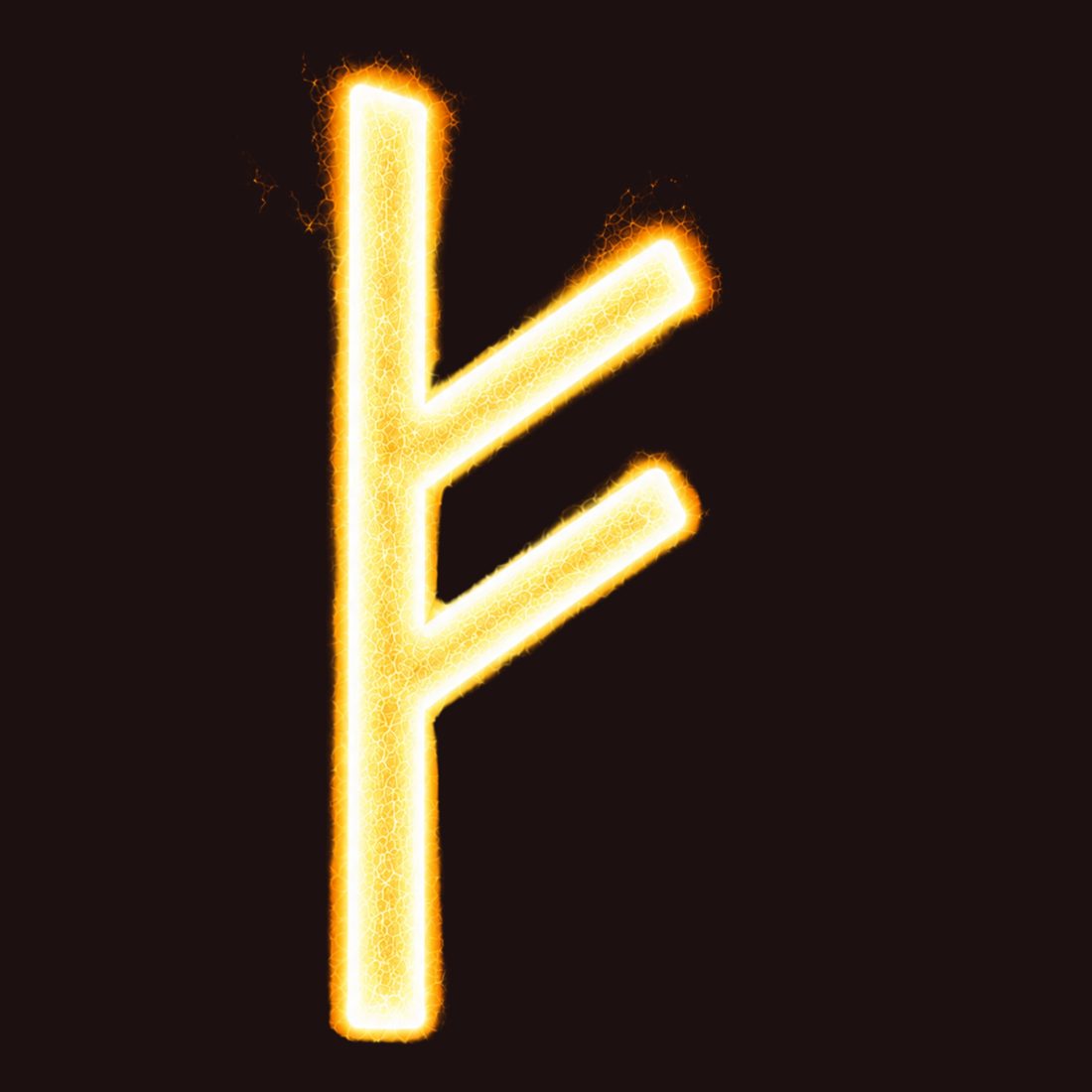
Elder Futhark
Fehu
Fehu: Why the First Rune Begins With Wealth in Motion
Long before written alphabets became ordinary tools of daily life, symbols carried identity, language, memory, and meaning.
Meaning & symbolism
Fehu: Why the First Rune Begins With Wealth in Motion
Long before written alphabets became ordinary tools of daily life, symbols carried identity, language, memory, and meaning.
Among the oldest runic writing systems used by Germanic-speaking peoples stands the Elder Futhark: 24 characters whose modern name comes from the sounds represented by its first six runes—F, U, Þ, A, R, K. The script is attested from roughly the second century CE and remained in use until around 700 CE. (World History Encyclopedia)
And the rune that opens that entire sequence is Fehu:
ᚠ
Its reconstructed Proto-Germanic name, fehu, referred to livestock or cattle and, by extension, movable wealth. The connection makes sense in a world where prosperity did not necessarily sit quietly in a bank account.
Sometimes, wealth had four legs.
But Fehu becomes far more interesting when we stop treating “wealth” as merely a synonym for money.
Because what the surviving tradition says about wealth is surprisingly complicated.
When Cattle Were Capital
To understand Fehu, we have to enter a world with a very different relationship to possessions.
Cattle represented tangible value. They could provide food, materials, status, and economic security. Unlike land or a permanent structure, livestock could also move, reproduce, be exchanged, given away, lost, or stolen.
That distinction matters.
The reconstructed name Fehu is strongly supported by related forms preserved in later Germanic languages. Old English feoh and Old Norse fé carried associations with cattle, possessions, money, or wealth. Even the modern English word fee belongs to the same linguistic family. (Wikipedia)
So the historical foundation of Fehu is not an abstract modern concept of “abundance.”
It is wealth with consequences.
Something valuable must be acquired, managed, protected, exchanged, and sometimes shared.
That gives this ancient rune a remarkably modern question to ask:
What are you doing with what you have?
The First Rune of the Elder Futhark
Fehu occupies the first position in the Elder Futhark, where it represents the f sound. The Elder Futhark itself contains 24 runes arranged traditionally into three groups of eight. (World History Encyclopedia)
It is tempting to interpret Fehu’s first position as historical evidence that ancient Germanic peoples deliberately placed prosperity at the philosophical beginning of existence.
We should resist that temptation.
The surviving evidence does not allow us to confidently assign that kind of elaborate spiritual philosophy to the rune’s position.
But symbolically, from a modern perspective, its position creates an intriguing starting point.
Before something can be transformed, something must exist.
Before something can be exchanged, something must be possessed.
Before something can grow, something must begin.
That makes Fehu a compelling symbol for potential put into motion.
And that distinction—between historical meaning and modern interpretation—is important throughout the study of runes.
The ancient evidence gives us the foundation.
What we build upon it belongs to interpretation.
The Rune Poems Complicate the Story
If Fehu were simply an ancient equivalent of a prosperity symbol, the story would be easy.
The surviving rune poems make it considerably more interesting.
These poems come from later runic traditions rather than directly from the Elder Futhark period, so they cannot simply be treated as instruction manuals explaining exactly what people centuries earlier believed about each Elder Futhark rune. They are nevertheless important witnesses to how rune names and associated ideas survived and developed.
And when they discuss the rune corresponding to Fehu, wealth is not presented as uncomplicated good fortune.
The Old Norwegian Rune Poem associates wealth with conflict among relatives.
The Icelandic tradition similarly connects wealth with discord among kin.
The Old English Rune Poem takes another direction: wealth is described positively, but with an expectation that it should be shared generously. (Wikipedia)
Suddenly Fehu looks different.
Wealth can sustain.
Wealth can liberate.
Wealth can also divide.
Its value depends partly upon the relationship between possession and responsibility.
That is much richer symbolism than simply “money is coming.”
Abundance Is More Than Accumulation
Modern spiritual and divinatory traditions have expanded Fehu into concepts such as abundance, prosperity, opportunity, gratitude, fertility, and personal growth.
Those interpretations should be recognized for what they are: later and modern symbolic readings, not documented definitions from the Elder Futhark period.
But that does not make them meaningless.
In fact, some become more interesting when placed beside the historical material.
Consider abundance.
We often imagine abundance as accumulation—the moment when we finally have enough.
Enough money.
Enough opportunity.
Enough security.
Enough recognition.
But Fehu’s association with livestock gives us another way of thinking about it.
Living wealth cannot simply be locked away indefinitely and forgotten. It requires attention. It consumes resources. It can reproduce. It can deteriorate. It can move from one person’s possession to another.
Wealth, in this sense, is dynamic.
The same is true of many things we value now.
Knowledge becomes more valuable when used.
Relationships survive through attention.
Creativity develops through practice.
Opportunity disappears when ignored.
Money itself is exchanged, invested, spent, saved, lost, earned, and redirected.
Even gratitude changes our relationship with what we already possess by forcing us to recognize value before chasing more of it.
Abundance may therefore be less about having and more about participating intelligently in the movement of value.
The Difference Between Possession and Stewardship
This may be Fehu’s most useful modern lesson.
Possession asks:
What belongs to me?
Stewardship asks:
What am I doing with it?
Those are profoundly different questions.
A talent neglected eventually weakens.
An opportunity continually postponed eventually closes.
A relationship taken for granted changes.
Money without direction disappears surprisingly easily.
An idea without Action remains an idea.
Fehu can therefore be interpreted not merely as the acquisition of resources, but as responsibility toward potential.
You have something.
Now what?
That may be money, time, knowledge, creativity, influence, attention, or simply another morning in which you get to decide what happens next.
The important part is movement.
Intention Gives Wealth Direction
Movement by itself is not enough.
Energy can be wasted just as easily as it can be cultivated.
That is where intention enters the symbolism.
Intention identifies the direction.
Action creates the movement.
Stewardship sustains it.
And over time, that process creates Transformation.
This is a much more demanding understanding of prosperity than waiting for abundance to arrive.
It asks us to participate.
Fehu does not have to mean something good is coming.
It can instead become a question:
What could grow from what is already here?
Prosperity Has a Current
There is another fascinating consequence of thinking about Fehu as movable wealth.
Value rarely exists in complete isolation.
Money moves between people.
Ideas move through communities.
Knowledge passes between generations.
Kindness alters relationships.
Creativity inspires more creativity.
One person’s opportunity can become another person’s beginning.
There is a current running through almost everything humans consider valuable.
Block that current completely and something often stagnates.
Direct it deliberately and it can become expansion.
This does not mean reckless spending, endless generosity, or the belief that giving something away magically guarantees its return. Fehu is not a historical promise of cosmic reimbursement.
It is a symbol through which we can examine the relationship between resources, movement, responsibility, and growth.
That is far more useful.
The Beginning of the Cycle
There is something beautifully appropriate about encountering Fehu at the beginning of the Elder Futhark.
Not because we can prove ancient rune users intended a grand spiritual journey beginning with abundance, but because modern readers can recognize something meaningful in the sequence.
Every cycle begins somewhere.
Every undertaking starts with whatever resources are available at that moment.
You rarely begin with everything you need.
You begin with something.
An idea.
A skill.
A dollar.
A conversation.
A decision.
A chance.
The mistake is believing that beginnings only count when they arrive fully formed.
Fehu suggests another possibility:
Recognize what is already in your hands.
Then move it.
What Does Wealth Mean to You?
This is where an ancient word for cattle reaches unexpectedly into modern life.
We have far more sophisticated financial systems than the people who first carved ᚠ.
But the fundamental questions surrounding wealth have not disappeared.
What is enough?
What deserves our attention?
What should be protected?
What should be shared?
What should be invested?
What are we accumulating simply because we have confused possession with fulfillment?
And perhaps most importantly:
What valuable thing are we allowing to remain motionless?
Fehu cannot answer those questions for us.
A symbol never needs to dictate meaning to be powerful.
Sometimes its purpose is simply to make the right question impossible to ignore.
That is why Fehu remains compelling after so many centuries.
The rune began with cattle and movable wealth.
Today, it can remind us that abundance is not necessarily something waiting somewhere ahead of us.
Sometimes abundance begins when we finally recognize the value already present—and choose to give it direction.
Feel the energy Follow your flow Make it so